
NK 1 -3 | Teacher Resource Sheets
Number Knowledge 1 – Place value (page 15)
Block numbers
Ask students to make numbers from place value blocks, assigning them the values below. It could pay to have a written reminder of the assigned value initially as students might have become used to these blocks as thousands, hundreds, tens and ones.
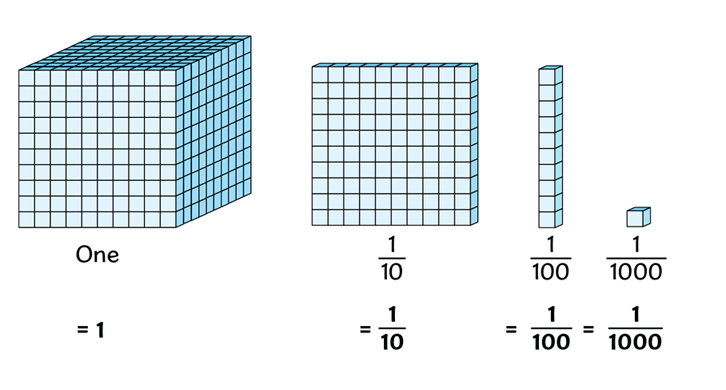
You could ask them to show the numbers they have made to a partner and ask their partner what the number is.
This displays a sheet where a number system devised with shapes is shown and students are asked to read some numbers.
Number Knowledge 2 – Nested place value (page 18)
Make a place value concertina
You could make one of these concertinas with a piece of A4 paper cut lengthwise in three strips, glued together end to end and folded concertina style. The laminated digit cards stick on with Blu-Tack so they can be changed.
The concertina can be opened to show the number of hundreds / tens in a four digit number. It is a good way for students to practise once they understand the concept of nested place value.
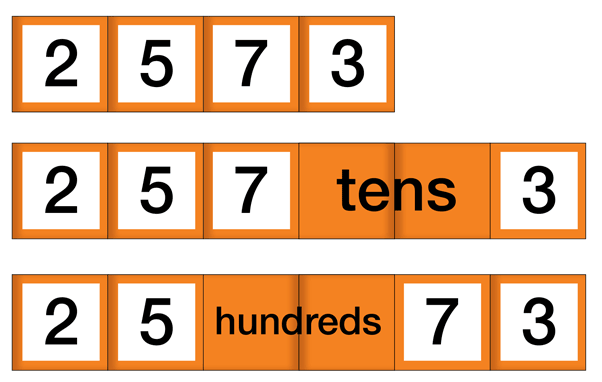
This example shows 257 tens or 25 hundreds. You could discuss with students the reason why there are 257 tens and why the 3 ones are not included. Students need to understand why the digits to the right are not considered rather than just learning to 'drop them off'. A lack of understanding here could cause confusion when using other strategies.
Cup of numbers for anyone?
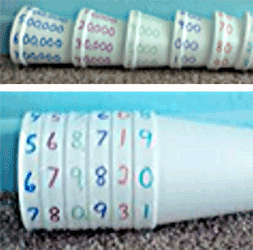
Instead of the concertina idea above, you could use cups instead. As the nested numbers are not quite so obvious, you could use this activity to generate random numbers for students to work with by rotating the cups.
Wooden spatulas
Use wooden spatulas (or ice block sticks) with different values in nested or non-standard written form marked on them, such as 100 tens + 3 ones; 12 hundreds + 6 tens; 8 ones + 4 tens + 3 hundreds. Students take five sticks from the pile and then race to order them smallest to largest. This is more challenging than it might seem.
Number Knowledge 3 – Addition and subtraction basic facts (page 20)
This displays a sheet with a dartboard that you can print. The dartboard could be placed on the floor and instead of throwing darts at it, students could drop paper clips onto it from a particular height.
Each student could drop three paper clips or a blob of Blu-Tack or a magnet and add up the numbers as their score.
The rules are displayed on the next page of the resource sheet