1. Temperature trouble
- This is a challenging investigation.
- Discourage students from looking up the answer on the internet.
- Students could use a spreadsheet to help them.
- The answer is -40.
2. How tall was she or he?
- If students have trouble with the decimals, you could allow them to use a calculator or round the decimals to whole numbers.
- You could have two groups working on this, one using the decimals, and one using the rounded numbers. They could compare results to see the difference that rounding makes to the answer.
- You may need to have taught scatter diagrams first if you want students to use their results to compare actual and estimated heights or students could use a spreadsheet.
Teaching ideas
This link displays several situations similar to the ones given in activity 1 and asks students to finish the formulae.
Teacher notes
- Students often find writing formulae and equations difficult. It is helpful for them to master this before learning to solve equations
so that students get the idea that an equation or formula represents a situation and isn’t just some numbers and letters that don’t
make sense.
Teaching Ideas
- Guess it first
Display the equation 4n + 6 = 16
Ask students to guess the answer.
You could make this a competition and put all of the guesses on the board with names and then see who has made the correct guess once the equation is solved. It is important not to give too much time or some students will solve the equation in their heads.
Choose one of the guesses and ask students to substitute it into the equation and work out the answer.
Example:
Guess 5 4 x 5 + 6 = 26 - too high
Ask students which guess you should choose next.
Keep doing this until the answer of 2•5 is found.
Teacher notes
- Estimate and improve is often called “Guess and check”.
- Guess (or estimate) and check is a useful technique for students to know.
Teaching ideas
- Box stands for ? (Building equations)
You could demonstrate by using empty boxes as the function machines, and blocks in a bag for the unknown, to show what happens when you build an equation.
For example, for 3n + 4 = 19, start with a bag of blocks and say “There are n blocks in this bag. If I put the bag into this function machine (empty box with a big • 3 on it), I will get 3 bags of blocks with n blocks in each. Then if I put all of these bags into the next function machine (empty box with a big + 4 written on it), then I will get 3 bags of n blocks plus 4 extra blocks.”
Then say “I know the total number of blocks is 19.”
Continue it to solve the equation by taking the number 19 and putting it back through the flow chart (empty boxes) and doing the inverse operations.
So, 19 cubes go into the box labelled +4, but the inverse operation is done, – 4, so 19 – 4 = 15.
Then 15 cubes are put into the box labelled x 3, but the inverse operation is done, ÷ 3, so 15 ÷ 3 = 5.
Now put 5 cubes back through the other way, doing the operations as shown on the boxes to see if you get 19 cubes.
5 x 3 = 15 and 15 + 4 = 19
Other online resources that might be useful
www.mathplayground.com/functionmachine.html
www.topmarks.co.uk/Flash.aspx?f=FunctionMachinev3
www.littlefishsw.co.uk/card/functionmachine.html
This link displays the equation 4n – 7 = 25 and a flow chart.
Work through building the equation using the flow chart.
You will need to be able to display this onto a write-on surface.
Ask students how they could find the value of n.
Once it is established that they have to “undo” all that was done, starting with the answer, the reverse flow charts are used to find
the answer.
These can be filled in.
Two more examples are given.
Teacher notes
- Knowing how an equation has been built is crucial for students to understand. Then they will know what is happening when either inverse operations or balancing both sides is used to solve the equation. Using either of these methods, the order in which the equation has been built is undone (in reverse order) to solve the unknown amount.
- You may need to recap inverse operations and give a bit of practice in recognising that adding 5 is the inverse of subtracting 5,
and so on.
This is a crucial step for students in understanding how to solve an equation.
- Emphasise the importance of writing down the answer after each step of the flow chart.
- Encourage students to check their answers by substituting them into the original equation or putting them through the flow chart.
Teaching ideas
Introduce the idea of balance. It may be helpful to use a real balance and blocks or counters to help.
- Counters or blocks on scales
Use counters and scales to show that you must do the same to both sides of the scale for it to remain balanced.
You could use materials to illustrate one of the examples on page 157.
- Investigation on page 161
You could use it as a class investigation.
Other resources
This is an interactive page that illustrates balance.
www.heymath.com/main/samples/us18/teacherstemplate.html
http://mathsnet.net/equation.html
A series of clips explaining equations starts here.
https://www.khanacademy.org/math/algebra/introduction-to-algebra/algebra_why/v/why-we-do-the-same--thing-to-both-sides--simple-equations
Teacher notes
- Emphasise that both sides of an equation will remain equal as long as both sides are operated on in the same way. Doing the
same thing to the values on both sides of the equations in the discussion on page 156 will help illustrate this. Note that it is
important that all terms on both sides of an equals sign are operated on. - Example - for the equation 3x + 3 = 15, some students when dividing both sides by 3 will only divide the 3 or the 3x by 3 but
not both.
Displays the Getting started on page 147.
You could put students into groups and have a race to see who can solve the puzzle first.
Teaching ideas
This link displays cards for you to print and cut out.
Give out the cards to groups of students to make the formula and then substitute given values into the formula.
For example, the formula for the area of a parallelogram is A = lh. Students will make the formula with the cards like this.
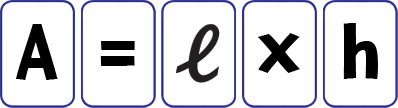
If A = 60 and l = 15, then cards can be substituted for A and l to make
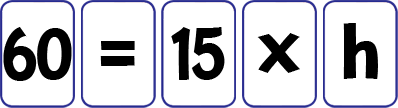
Repeat for the other formulae given.
Ask students how they can find the value of the letter in each.
Teacher notes
- Some students may find this section difficult and need to be reminded about how to solve an equation, for example by using a balance or flow charts and doing inverse operations.


 Practice it (Teaching resource sheet 47)