Rich tasks
- These are problem solving open-ended questions that require students to investigate multiplicative strategies with whole numbers. They can be given at the start of a topic and done as the students gain enough knowledge to complete them, inserted into a topic at an appropriate place, or given as homework, or extension.
- Strategy chart competition
- Dicey games
> More on "Rich tasks for this Chapter"...
1. Strategy chart competition
- Students should have been exposed to the main strategies for multiplication and division by the end of this chapter. This task is a good opportunity for them to summarise what they know and be able to find suitable examples of each strategy to show that they understand the sorts of numbers to use it with.
- If this task was done at the beginning of the chapter, students could add to the chart as they become familiar with each strategy.
2. Dicey games
- The games given in this task are quite uninteresting, purposely. Encourage students to find exciting ways using dice to practise multiplication and division skills.
Divisibility tests
- Apply the divisibility tests for 2, 3, 4, 5, 6, 8, 9 and 10.
> More on "Divisibility tests"...
Teaching ideas
Roll a die two or three times and put the numbers on the whiteboard.
Ask “What numbers can you tell I am NOT divisible by?"
Students should be able to say if the number is divisible by 2, 5 or 10.
Talk about the divisibility tests one by one then get students to say if the number on the whiteboard is divisible using each test.
Take a vote.
You could put another number on the board and ask students to stand if it is divisible by, say, 4. If they are correct they get to
stay standing.
If not they sit down.
This link displays this chart with numbers.
It will work best if you can project it onto a write-on surface.
Students decide which numbers are divisible by 10, 5, 4 or 3 and shade them on the chart.
Teacher notes
Order of operations
- Know the order of operations and apply them to solve problems.
> More on "Order of operations"...
Teaching ideas
Divide the class into groups or pairs.
Choose a target number such as 30.
Ask students to come up with a calculation that has answer 30 with as many different operations in it as possible.
Example 5 x 4 + 12 - 2 = 30
Display each group’s calculation and discuss it and use it to introduce the order of operations.
Once you have discussed the rules of the order of operations or students have discovered them, see if each group can come up with a different calculation.
Example 4 + 3 x 6 + 56 ÷ 7 = 30
This link displays questions such as 3 ___4 ___ 2 = 11 and asks students to fill in the operations to make it true.
The answers are given on another displayable sheet.
It will be best projected onto a write-on surface.
This link displays the instructions for this game.
 Number tiles 1 to 20
1. Arrange the tiles face down.
2. Take turns to turn over a tile so everyone can see it. 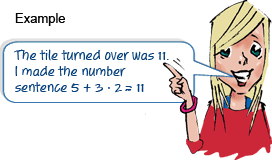
3. The first person to make up a correct number sentence with the number on
the tile as the answer takes the tile. You must use at least two different
operations in your sentence.
4. The winner is the person who has the most tiles once all of them have been taken.
Challenge
Play the game but make number sentences with three different operations.
Teacher notes
- Emphasise that you must work from left to right doing first the brackets.
- Then go back to the beginning and work from left to right doing indices.
- Then go back to the beginning and work from left to right doing multiplication and division as you come to them (multiplication and division have equal priority when you work from left to right).
- Then go back to the beginning and work from left to right doing addition and subtraction as you come to them (addition and subtraction have equal priority if you work from left to right).
- Students could make a display of the order of operation rules for the wall or their books.
Multiplying using proportional adjustment
- Use doubling and halving, thirding and trebling etc to solve multiplication problems.
> More on "Multiplying using proportional adjustment"...
Teaching ideas
This link displays these three questions.
18 x 8, 68 x 5, 15 x 6
These are shown step by step done using two different strategies, one of which is doubling and halving and one is thirding
and trebling.
Discuss each strategy and decide which is the most efficient.
This link displays the instructions for a game.
This link displays an example of how to multiply by 25 by multiplying by 100 and then dividing by 4.
Students are then asked to work out some other multiplications by 25.
Teacher notes
- If the numbers are appropriate, this strategy can turn a difficult multiplication into a very easy one. Encourage students to look at all multiplications to see if this strategy is appropriate to use.
Dividing using proportional adjustment
- Use proportional adjustment to solve division problems.
> More on "Dividing using proportional adjustment"...
Teaching ideas
This link displays this question.
72 ÷ 4
This is shown step by step using two different strategies, one of which is using proportional adjustment.
Discuss each strategy and decide which is the most efficient.
This link displays the instructions for a game.
You could use it as a class discussion after working through the worked example on this same page.
Teacher notes
- This strategy can again make the division easy if the numbers are appropriate. Encourage students to look for opportunities to
use it. - Students can often understand this strategy intuitively more easily than teaching them a “rule”.
- Teaching students how to multiply by 25 by multiplying by 100 and then dividing by 4 is a useful multiplication technique.
Multiplying and dividing using proportional adjustment
- Using proportional adjustment to solve a range of multiplication and division problems.
> More on "Multiplying and dividing using proportional adjustment"...
Teaching Ideas
Use any of the teaching ideas that have not been used from “Multiplying using proportional adjustment” or “Dividing using proportional adjustment”.
Teacher notes
The teacher notes from “Multiplying using proportional adjustment” and “Dividing using proportional adjustment” apply to this section as well.
Dividing with remainders
- Understand that some divisions give a remainder and know how to choose an appropriate way to give the remainder depending on the problem.
> More on "Dividing with remainders"...
Teaching ideas
Put the name of each student in your class onto a card and put the pile of cards on a table. Ask the class or group to put the cards into groups of three. Note if there are any left over students.
Write up the division. For example if there are 28 in your class you would write 28 ÷ 3 = 9 remainder 1.
Repeat for groups of 4, 5, 6, 7, 8, and 9.
If you have a prime number of students like 23, 29 or 31 you could discuss why groups can’t be formed without remainders.
- Discussion on page 59 and the examples in the teaching box
You could use it as a class discussion.
Teacher notes
- Students should learn the prime numbers below 30.
Multiplying using written methods
- Understand the algorithm for multiplication and use it when it is more efficient than a mental method.
> More on "Multiplying using written methods"...
Teaching ideas
You could use this discussion with the class/group.
This link displays the place value materials for each step of the calculations from the examples on page 64, 27 x 4 and 279 x 3.
Discuss whether or not a mental strategy would be more efficient.
Divide the class into two groups.
Give these calculations one by one and ask one group to do them using mental strategies and the other to do them using a
written method.
56 x 7 88 x 9 74 x 8 145 x 7 236 x 9
Discuss which calculations are best done using a written method.
Discuss the sorts of numbers that work well with mental strategies – numbers that can be rounded so that rounding and compensation can be used and numbers that when partitioned give easy calculations that can be done mentally.
Teacher notes
- It is important that students understand that the written method is a short-hand way of writing the place value partitioning method. It is not helpful for students to learn this written method as an algorithm.
- Encourage students to use a mental strategy if they can. Some of the questions in the activity can be done more efficiently mentally. Help students to identify these or get students to race each other with one doing it mentally and the other using a written method.
- Encourage students to estimate the answers first.
- Students who don’t fully understand the written method often forget that they are multiplying by say 60 and not 6 in a multiplication such as 67 x 7.
Dividing with written methods
- Understand the algorithm for division and use it when it is more efficient than a mental method.
> More on "Dividing with written methods"...
Teaching ideas
This link displays the place value materials for each step of the calculation 78 ÷ 6.
Discuss whether or not a mental strategy would be more efficient.
- Race to the answers
- You could divide the class into two groups to do the practical on page 64 or give these divisions for the groups to do, one using mental strategies and the other using a written method.
484 ÷ 4 235 ÷ 5 336 ÷ 8 231 ÷ 3 210 ÷ 6
Teacher notes
- Students should be encouraged to use a mental strategy if questions in the activity can be done more efficiently mentally. Students may need help to identify these.
- Students should understand that the written method is a short-hand way of writing the place value partitioning method. It is not helpful if students learn this as an algorithm.
- Estimating the answers first will assist students to check if their answer is reasonable.
Choosing whether to use a mental, written or machine method
- Understand when it is best to use a mental, written and machine method.
> More on "Choosing whether to use a mental, written or machine method"...
Displays the Getting started on page 47.
You could extend this by looking at twentieth century inventions and comparing them to nineteenth century inventions.
Teaching ideas
This link displays three problems and asks students if they had to do one mentally, one using written methods and one using a calculator, which problem would they choose for each method and why.
You could work through some of the questions from Activity 11 discussing which methods are best for each step.
Teacher notes
- Encourage students to use a mental method first if they can, then a written method and lastly use a calculator (or other machine).
- The problems in this section are all multi-step problems and may require pairing poor readers with better readers.
- Encourage students to estimate the answers first.