Teaching ideas
You could work through this with the class.
When you get to 1/8 this is more difficult as students will have to shade half squares. They should end up with 12 1/2 out of
the 100 squares shaded.
Encourage them to write this as 12.5/100 and then ask “How many would be shaded if each hundredth was divided into ten squares to get thousandths?" They will see that the answer is 125 and so it can be written as 125/1000 or 0.125.
Also show that 1/8 is half of 1/4 and 1/4 = 0.25 so half of this is 0.125 because 12.5 is half of 25.
This link displays some decimats and leads students through changing a quarter to a decimal.
This link displays some decimals in place value charts and their equivalent decimat diagrams and fractions.
Example:
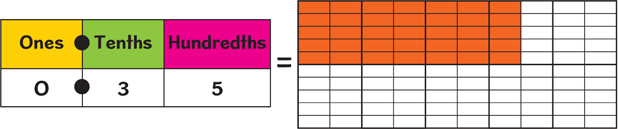
Students are asked to write them as fractions.
This link displays some fractions with denominators of 10, 100 and 1000 and asks students to fill in the missing numbers to
cancel them.
You will need to be able to project this onto a write-on surface.
This link displays some fractions and asks students to fill in the missing numbers to make them into fractions with denominators
of 10, 100 and 1000.
You will need to be able to project this onto a write-on surface.
Teacher notes
- Students need a sound understanding of decimal place value and simplifying fractions before doing this section.
- Materials such as decimats divided into hundredths as well as tenths are an excellent way to show the relationship between decimals and fractions.
- Once understanding has taken place encourage students to learn some of the basic equivalences such as
0.125 = 1/8 0.333… = 1/3 2/3 = 0.666… etc
- It is important that students realise that decimals are the equivalent of fractions with denominators of 10, 100, 1000 etc. If a fraction cannot be made into an equivalent fraction with one of these denominators then it cannot be described by an exact decimal (terminating decimal).
- It is very important that students realise that fractions and division are linked. Students may not be aware that 2/3 = 2 l 3.
- Remind students to always give fractions in their simplest form.
- Encourage students to discover that 0.4 is the same as 0.40 and 0.400.
- Fractional expressions have equivalent decimal and percentage expressions.
Teaching ideas
This link displays the Getting started on page 31 as a class discussion.
Discuss other places where fractions and percentages are found.
It is important for students to understand that a whole is 100% and that where a whole has been divided into percentages they should add up to 100%.
This link displays a set of ten cards for you to print and cut out (and possibly laminate). Give a card to each pair or group to find the odd one out. For example 78%, 0.78, 39/50 and 7.8 – the odd one out is 7.8 because this does not equal the other three. They must be able to give a reason why it is the odd one out. For example 7.8 is 780/100 so is 780% not 78%.
This link displays a set of dominoes for you to print and cut out (and possibly laminate). The dominoes match a percentage to either a fraction or decimal.
Teacher notes
- Make sure students understand that decimals, fractions and percentages are all related and can all describe the same proportion. Fractions, decimals and percentages are representations of parts of a whole.
- When comparing proportions they need to be converted to all fractions with the same denominator, all decimals or all percentages.
- Some students have difficulty understanding percentages greater than 100%. It is important to give examples like lambing percentages from real life.
Teaching Ideas
Use any of the teaching ideas that have not been used from the previous sections in this chapter.
Teacher notes
The teacher notes for the previous two sections apply to this section as well.


 Fractions to decimals (Teaching resource sheet 9)