
- Home >
- Free Support & Guides >
- Online Teacher Support >
- Number & Algebra Strand Chapters 1 to 9 >
- Chapter 1 Place value, rounding, estimating and ordering >
- CH 1|Overview & Teacher Resource Sheets

Number & Algebra
Chapter 1 | Place value, rounding, estimating and ordering
Overview & Teacher Resource Sheets
Rich tasks
- These are problem solving open-ended questions that require students to investigate number properties. They can be given at the start of a topic and done as the students gain enough knowledge to complete them, inserted into a topic at an appropriate place, or given as homework, or extension.
- Decimal currency in New Zealand
- World’s largest and smallest
> More on "Rich tasks for this Chapter"...
1. Decimal currency in New Zealand
- Students can research this by talking to grandparents or elderly neighbours. Decimal currency was introduced to New Zealand in 1967 so there will still be many who remember using pounds, shillings and pence.
- Encourage students to compare the two systems and realise that working with a decimal system is much easier.
2. World’s largest and smallest
- Depending on the numbers found, it could be difficult to get all the numbers on a single number line, even one that went right around the room.
- You could limit the task to just “largest” or just “smallest” which would reduce the range of the numbers somewhat.
- You could also limit the category, such as looking at the tallest and shortest buildings around the world.
Multiplying and dividing by 10, 100 and 1000
- Use their understanding of decimal place value to multiply and divide by 10, 100 and 1000.
> More on "Multiplying and dividing by 10, 100 and 1000"...
Teaching ideas

This link displays some cards with digits and decimal points for you to print.
Ask for volunteers and give them the cards 3, 7, 8, 0, 0, 0 and the decimal point card.
Ask them to make the number 873.000 and stand with their backs against the board.
Ask for the place value of each digit and write this on the board above the heads of the students.
Now ask, what happens if I multiply 873 by 10?
The students all move one place to the left on the chart EXCEPT the decimal point – ask why this stays where it is.
Get the students to go back to 873.000.
Repeat for • 100, • 10000, l 10, l 100, l 1000.
Ask for more volunteers and repeat for other numbers such as 43.87 etc.
This link takes you to a spreadsheet package or you could use the place-value chart on the link below and display it on a write-on surface.
Number
1 Write each of these numbers in the top row of one of the charts.
Use a separate chart for each number.
856 43 8.7 2.95 17.04 0.042
Use a calculator or spreadsheet to multiply the number by 10, 100 and 1000 and divide it by 10, 100 and 1000.
(Remember to carry out each calculation on the original number).
Under the original number write the answers to all six calculations for that number.
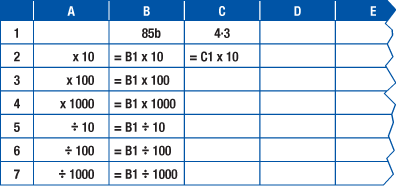
2 What happens to each digit when you multiply a
number by 10? by 100? by 1000?
Does the number get bigger or smaller?
3 What happens to each digit when you divide a number by
10? by 100? by 1000?
Does the number get bigger or smaller?
4 Write some rules for how to multiply and divide by
10, 100 and 1000.
Make sure your rules work for both whole numbers and decimals.
5 What rules would you use if you wanted to multiply by 10 000? divide by 10 000?
6 Summarise your rules in tables, one for multiplication and one for division.
What patterns do you notice?
7 Challenge
Use the patterns in your tables to write a rule for multiplying and dividing by 0.1 (1/10).
Add these rules to your tables.
How are dividing by 10 and multiplying by 0.1 related?
How are multiplying by 10 and dividing by 0.1 related?
Teacher notes
- Emphasise that it is the digits that move and discourage any rule which suggests adding or subtracting zeros as this does not work with decimals.
- Encourage students to look at their answer to see if it is sensible.
- It is helpful to look at patterns such as
0.7 • 10 = 7 1.4 l 10 = 0.14
0.7 • 100 = 70 1.4 l 100 = 0.014
0.7 • 1000 = 700 1.4 l 1000 = 0.0014
6 • 10 = 60
6 • 1 = 6
6 • 0.1 = 0.6
6 • 0.01 = 0.06
6 ÷ 10 = 0.6
6 ÷ 0.1 = 60
6 ÷ 0.01 = 600
- Our number system uses base 10 and the understanding of “nested place value” is central to applying operations on both whole numbers and decimal fractions.
Using nested place value to add and subtract decimals
- Write a decimal addition or subtraction with their nested place values to add and subtract.
> More on "Using nested place value to add and subtract decimals"...
Teaching ideas
This link displays the place value pictures to show
4.3 – 2.78
Students are asked to show this subtraction using place value materials.
1.4 – 0.87
Teacher notes
- An understanding of nested place value is essential.
- Remind students that other strategies may be more efficient. These are covered in chapter 4.
Ordering decimals and integers
- Use place value understanding to order decimals with up to three decimal places.
Place positive and negative decimals and integers on number lines with adherence to scale.
> More on "Ordering decimals and integers"...
Teaching ideas
This link displays some cards for you to print and some cards to enable you to make a number
Using Blu-Tack®, put the integers from -5 to +5 along the wall at equal intervals. You could make the line on the floor or outside.
Either print off the cards given or write these numbers on pieces of paper.
Set 1:
-2 -2.5 -3 0 1 0.775 1.225
-0.25 2.7 2.55 -2.575 -0.7 0.75 -2.05 -1.25
Set 2:
-1.6 -0.067 1.4 0 -2 -3.04 0.36
-0.86 4.15 -2.5 -1.01 2.65 1.5 -3.8 3.74
Give each volunteer one number on a card or piece of paper and ask them to put their number on the number line.
You could use Blu Tack and students could attach their cards to the line. Once they have done this, ask them to take account of scale and move their cards apart or together so that they end up being about the right distances apart. For example there will be more distance between 0 and 0.7 than between 0.7 and 0.75.
This link displays the instructions for this game.
- Choose a leader.
- The leader chooses a decimal number less than 100 with between 3 and 5 digits.
- The rest of the class/group are allowed to ask questions to which the leader can answer yes or no.
- The student who finds the numbers is the winner.
Encourage students to ask questions like “Are there two digits after the decimal point?” or “Is the second number less than 5?” rather than “Is it 13.76?”. You may need to choose someone to record the answers on the board so that students don’t lose track of what they already know or encourage students to keep track of what they know themselves.
- I am taller than you (Note if you have any particularly tall or short students then you will need to consider whether doing this starter is appropriate. You could ask students to choose a decimal number between 1 and 2 with 1, 2 or 3 decimal places instead.)
Ask the students to write down their height in metres on a piece of paper, for example, 1.58 m
The whole group/class puts themselves in order from tallest to shortest.
Asks questions about how they did this.
Discuss which digit they looked at first.
Teacher notes
- Encourage students to write numbers using nested place value if they are having difficulty. So 0.7, 0.75 and 0.775 could be written as 700, 750 and 775 thousandths respectively.
- Encourage students to use or imagine a number line if they are having difficulty.
- Students should be reminded to read 0.69 as zero point six nine and not zero point sixty nine because otherwise they could think that 0.69 is greater than 0.7 because 0.7 is read as zero point seven.
Working with materials is the best way to help students understand why 0.69 is smaller than 0.7 etc.
Sometimes converting to fractions helps as well. 69/100 is smaller than 70/100. It also encourages students to understand the links between decimals and fractions and gives practice at changing between them.
Rounding decimals
- Round numbers to the nearest tenth, hundredth and thousandth and round sensibly when calculating the answer to a problem.
> More on "Rounding decimals"...
Teaching ideas
This link displays questions such as:
- The ferry wants to know the length of my car to the nearest 10 cm. My car is 425 cm long.
- The doctor wants to know my height to the nearest cm. I am 163.5 cm tall.
- What would you round these to?
- the length of your room
- the population of China in millions
- the length of ribbon or material sold in lengths to the nearest 10 cm, when the length needed is not a tidy 10 number
- the amount of cash needed for a planned shopping trip
This link displays some number lines in tenths and hundredths and some numbers.
You need to project it onto a surface that can be written on, such as a whiteboard.
Ask students to put the numbers on the appropriate number line to round them to the nearest whole number, tenth or hundredth.
- Discussion page 25
Discuss what would happen if the smallest place value digits were compared first. Use the example $34.68 and $87.74. If you compared the hundredths digit first instead of the tens then this would indicate that $34.68 is greater than $87.74 and students will know this is not true.
Teacher notes
- Students need to understand place value well.
You may need to revise place value.
- A good way to illustrate rounding is using a number line. It is a visual way of showing that a number is closer to one end of the line than the other. Encourage students to draw the number lines themselves when rounding.
- Point out that in the case of 5, which is halfway between, it is the convention to round up.
- Rounding and estimating sensibly are dependent on strong place value understanding.
- Encourage students to round sensibly by thinking about the context and the accuracy to which the answer would normally be given. For example, you can’t have 2.3 humans as that is not sensible. It would also not be sensible to say that the width of a desk, when calculated, was 1.687976 m as no one measures to this accuracy.
- When numbers that have been rounded to the nearest tenth, for example, end up with no tenths, it is important to put 0 in the tenths place so that everyone knows the number has been rounded to the nearest tenth and not to the nearest whole number.
For example, 5.03 to the nearest tenth is 5.0 not 5.
This is important in many practical situations. Imagine if a 5 m van could fit in a space but it would not fit if it was 5.1 m. Anyone being told the van was 5 metres long might assume that it could be anything up to 4.99999… m, if it had been rounded to the nearest metre, but if the length was written as 5.0 m then it would be known that it was no longer than 5.04 m.
Estimating
- Make sensible estimates to the answers to calculations.
Teaching ideas
This link displays Getting Started on page 15 to use as a class discussion.
This link displays a sheet with some estimations for students to match with the best estimate.
You will need to display this on a write-on surface.
- More than one way
Put the calculation 581/72 on the board and ask students to work out an estimate for it.
Ask them to find the answer using a calculator.
Work out whose estimates are closest and ask them to explain how they did them to the rest of the class/group.
- Discussion page 28
You could use this as a class discussion.
Teacher notes
- Emphasise that there is sometimes more than one possible way of making an estimate.
Example 562 • 2.4 could be estimated as 600 • 2 or 600 • 2.5 or 560 • 2.
- Students often have trouble estimating the answers to divisions because they round one or both numbers to the nearest 10 or 100 rather than looking for multiples of the divisor (“nice numbers”).
For example, 708 l 8 is better rounded to 720 l 8 than 700 l 8.

Caxton Educational LtdPO Box 36411, Christchurch 8146, New Zealand. Telephone: +64 3 366 7091 |
© 2026 Caxton Educational Ltd Publishers. All rights reserved.