Teaching ideas
This link displays some 3-D shapes.
Ask students to sketch the net for each shape.
You could give one shape to each group or student and then discuss which nets are correct and what was wrong with the nets that were incorrect.
Teacher notes
- Students often have difficulty with nets, especially when specific dimensions are required.
- Remind students that sides that meet to make an edge must be of equal length.
- Encourage students to count the number of shapes needed for the net of the 3-D shape and to check that each shape has the correct dimensions.
- Encourage students to imagine how the net will fold to make the 3-D shape by thinking about which sides will meet to make an edge of the shape and which corners will meet to make a vertex.
- The number of vertices, edges and faces on the 3-D shape can be worked out by looking at the net.
Teaching ideas
 Multilink cubes
Ask students to get four Multilink cubes each.
Ask pairs of students to make a model each with the four cubes.
Ask the students to swap models in their pairs and to draw their partner’s model on isometric paper.
The partners check the drawings and those students who have drawn their partner’s model correctly get five points.
Repeat this three times.
Those students with 15 points choose someone who didn’t get 15 points and teach them how to make an isometric drawing.
You could get students to race each other to see who can make all of the models first (if you have sufficient interlocking cubes).
Then get students to compare models and answer the rest of the questions in the practical.
Teacher notes
- Isometric paper must be orientated the correct way. Encourage students to find a way of remembering which way is correct.
Some of these ideas could be shared. - It is important for students to understand that some cubes may not be able to be seen on an isometric drawing, which means
that there could be several different 3-D models that have the same isometric drawing. - Some students have difficulty with isometric drawings and they may need plenty of practice. Isometric drawing skills lead on to
being able to make perspective drawings so it is important that students grasp them well. - Make students aware of the fact that isometric drawings can be made without isometric paper. They could practise doing this.
The angles made with the horizontal must be 30°.
Teaching ideas
- View it this way and that
Instruct students how to use Google Maps to find their house and look at the street view and the satellite view.
Ask students what information they can tell about their house from each view.
Ask students to:
Draw the front, side and plan views of an unusual object, perhaps one you have at home.
Each set of views is held up and the first person to guess the object gets 5 points.
Multilink cubes
This link displays three views for a 3-D shape.
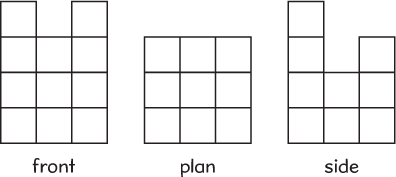
Students are asked to make the model using the views and
compare their model with others.
Ask if their model is the only possible model with these views.
Ask them then to work out the maximum and minimum number of cubes that could be used to make a model that has these views by making them.
You could work through practically with a class or group.
Teacher notes
- Encourage students to think of themselves as having been shrunk by a magic potion when they look at the front, top or side. This encourages them to draw only those faces directly in front of the view.
- Students might need the models in front of them when drawing the views.
- The example on page 280 is hard to follow and would be best modelled with equipment.
Teaching ideas
This link shows a 3-D shape for students to sketch the net, the front, right side and plan views.
Teacher notes
- It is important for students to be able to relate nets and views and 2-D drawings such as isometric drawings, as they are all different ways of representing the same 3-D object.
- Remind students that nets are used to construct 3-D objects and that views can also be used to construct a 3-D object. Engineers and builders in particular use views to build structures.
Teaching ideas
This link displays the Getting started on page 269. You might also like to explore this link about Möbius strips.
http://www.cut-the-knot.org/do_you_know/moebius.shtml
Other resources
You could use Google SketchUp or something similar to enhance the teaching of this unit.
PC
http://www.sketchup.com/
Mac
https://help.sketchup.com/en/article/60107
This is a youtube tutorial on Google SketchUp.
https://www.youtube.com/watch?v=UsHRGDvN4sM
This website might be useful when teaching perspective.
https://www.instructables.com/id/How-to-Draw---Basic-Linear-Perspective/
This website gives ideas for using photography to create funny perspective pictures.
https://designyoutrust.com/2012/08/35-creative-examples-of-forced-perspective-photography-2/
Teacher notes
- Artists use perspective drawing because it gives the drawing depth by making further away objects or parts of objects smaller, which is how our eyes see them in everyday life.


 Sketch a net (Teaching resource sheet 77)