Teaching ideas
This link displays the Getting started on page 255. You could divide the class into groups and have a race to see which group can complete the table first.
This link displays statements for students to decide if they are true or false.
You could divide the class into groups and give them five minutes to decide if the statements are true or false.
This link displays all of the 2-D shapes mentioned in the table in question 1 of the Check up. Either give these shapes to students to work with to help fill in the table or discuss each as a class.
The second sheet displays a completed copy of the table in question 1 of the Check up on page 256 for students to check against.
You could print copies for students to paste into their books or you could display it on a write-on surface and fill it in as a class or group.
Teacher notes
- Considering symmetry is useful in helping students to work out the properties of shapes.
- Question 5 in activity 1 on page 259 is aimed at getting students to see that a shape has many properties but only a few are needed to fully describe the shape (minimum definition). For example, if a shape has four equal sides and four right angles it must also have two pairs of parallel sides.
- The practical on page 260 could be done with a computer using Microsoft Word or similar. After choosing the square shape, use the shift key to constrain the shape to a square, then copy and paste to create identical squares. Transparency and colour can be set through the fill colour menu.
Teaching ideas
This link displays some photos of real-life shapes.
Ask students to write down as many properties as they can about each.
Ask students to name the shapes.
Teacher notes
- It is important that students are able to identify classes of shapes such as prisms and know that the cross section of the prism could be any polygon.
- A pyramid can have any polygon as its base.
- Students could make 3-D shapes that have edges using drinking straws and pipe cleaners or toothpicks and Blu-Tack®.
Teaching ideas
Use the cards from Black Line Masters Game - These make a set - 2-D shapes and Game - These make a set - 3-D shapes (laminate them before cutting them out).
Give one set of shapes to each group of students and ask them to sort the shapes into these groups.
Parallelograms
Kites
Quadrilaterals
Squares
Rectangles
Trapeziums
Rhombuses
Triangles
Equilateral triangles
Isosceles triangles
Right-angled triangles
Prisms
Pyramids
Polyhedrons
Regular polyhedrons
Cylinders
Students will quickly realise that some shapes are in more than one group. For example, all of the squares are also rectangles
and all of the parallelograms, kites, squares, rectangles, trapeziums and rhombuses are also quadrilaterals.
Ask students to draw circles or squares around the groups of shapes to form a diagram of classes and subclasses for 2-D and
3-D shapes.
Example:
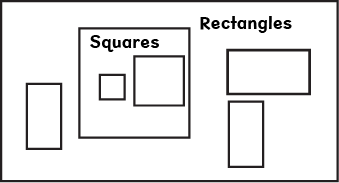
You could do this activity outside or in the hall so that the shapes can be spread out. You could use string or chalk to divide up the sets and show overlapping sets.
Teacher notes
- A cylinder is not a prism because its cross section is not a polygon.
- Encourage discussion as to why some shapes are subclasses of others and why some classes are disjoint.
Teaching ideas
Ask students to draw these angles.
90º 45º 76º 34º
Discuss which scale on the protractor to use and where to place the middle of the protractor (at the end of the first arm drawn).
Teacher notes
- It is important that students understand that a triangle can only be drawn using a ruler and protractor if they are given either one angle and the lengths on either side of it or one length and the angles at both ends of the length given. Likewise students can only use a pair of compasses to draw a triangle accurately if they are given all three lengths.

 Euler’s rule (Getting started 15)