Teaching ideas
This link displays three different enlargements of Ziggy.
Ask students what is different about the enlargements and why each is in a different place on the grid.
Ask how an enlargement could be defined so that the image would be in a particular place as well as being a particular size.
Also, use this resource when you introduce “Finding the centre of the enlargement”.
You could use this as a class discussion when looking at how to use horizontal and vertical distances to draw an enlargement.
This is much easier than measuring if an enlargement is drawn on squared paper.
You could use this as a class discussion to look at what might happen if you had a fractional scale factor.
This link displays five enlargements and a box with the scale factors, 1, 2, 3, 1/2, 1/3.
Put students into groups and ask them to match the enlargements and the scale factors as fast as they can.
Ask for answers and if their answers differ ask students to justify their answers.
You could display on a write-on surface and work through as a class or group.
You could display on a write-on surface and work through as a class or group.
Teacher notes
- When drawing an enlargement on a grid, encourage students to count squares rather than to measure distances. The number
of horizontal and vertical squares from any point on the original shape to the centre of the enlargement must be multiplied by the
scale factor. - You could use a computer to draw enlargements by using a programme such as Microsoft Word with the grid lines turned on.
If you increase the transparency of the shape, the grid lines will show through. - Ensure that students understand that fractional scale factors produce smaller rather than larger images and that they
understand why. - Point out the link to maps and making models.
- Point out the link to ratio – the ratio of any length on the image to the corresponding length on the original is the same as the
scale factor.
Teaching ideas
This link displays the Getting started on page 237 to use as a class discussion.
This link displays a copy of the table on page 248 and asks students to vote to decide which properties the majority think are invariant under each transformation. Record the results.
Students then carry out the practical on page 246 to discover if they voted correctly or not.
Teacher notes
- Students can have difficulty visualising rotation. One way to help remedy this is to use the rotate button on the computer to give practice. Ask students to sketch how simple shapes will look when rotated and then rotate the shapes on the computer to check.
- It is important that students are able to identify the invariant properties for each transformation because knowing this will help them when drawing images and tessellating.
- Emphasise that the centre of rotation always stays in the same place as a shape rotates.
- Point out that architects, graphic designers, engineers and crafts people all use transformations when working.
Teaching ideas
This link displays some shapes (the special quadrilaterals, pentagon, hexagon, etc) and asks students to work out how many triangles each can be divided into. You could use this with the practical on page 250 question 3 part b so that you could work through this with a class or group.
Teacher notes
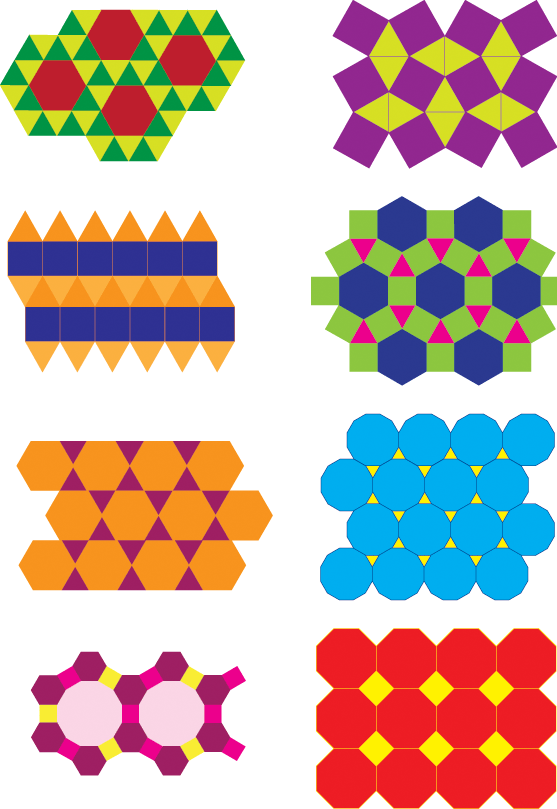
- This section is best taught practically with students testing which shapes tessellate and which do not. There are commercially available packs of shapes or you could photocopy and laminate Black Line Master Chapter 14 - Practical - Tessellations, cut out the shapes so students can easily manipulate them and decide how to fit the regular shapes together to make semi-regular tessellations.
- Students could search images on the internet for examples of real-life semi-regular tessellations.
- You could use the resources on the tki digital learning site for geometry digital learning – you will need to log in for this site.
http://www.tki.org.nz/Digistore
- All quadrilaterals tessellate, but the only regular shapes that tessellate are an equilateral triangle, a hexagon and a square.
- These are the eight semi-regular tessellations.


 At the centre (Teacher resource sheet 69)