1. Display time
- This task pulls together all of the strategies learnt in chapters 1 and 2.
- It could take a long time for individual students to do this task so it might be best done as a group. To ensure that all students are involved with all of the strategies, encourage them to discuss the strategies first. Find a good example for each as a group and then give one strategy to each student in the group to work on for the display.
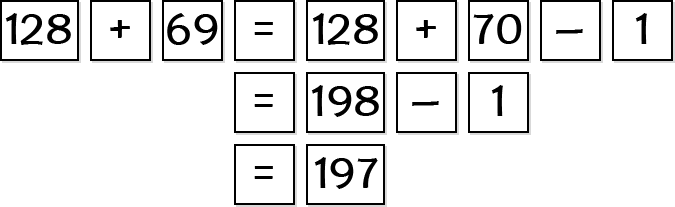
- Another good way of involving the whole group is by having students create a play that involves all of the different strategies. Students could make up a question that involves an addition or subtraction calculation and decide on a strategy they would use to solve it. Each student in the group could be one of the numbers, together with its operation, that would be used in the calculation. They would act out the solution to the question explaining when and where their number is used. For example the addition 128 + 69 would need:
2. Practice time
Students should know points 1 and 2 from the “Students should already know” button at the top of the page.
This is a challenging task.
Use the template provided if students find this task difficult.
One of the better ways to tell if students understand a strategy is to get them to write a problem for it.
Teacher notes
- Students must have a good grasp of chapters 1 and 2.
- It is important that students are able to choose an efficient strategy based on the numbers in the calculation rather than use the same strategy each time.
- Sometimes there is more than one efficient way to do a calculation. Students need to know that sometimes it comes down to personal preference.
- Encourage students to record their thinking in a variety of ways and move towards recording without diagrams.
- It is useful to have copies of pre drawn number lines. Click on the following Printable Master links to download a pdf.
Empty number lines 0-10
Empty number lines 0-20
Empty number lines 0-50
Empty number lines 0-60
Empty number lines - hundredths
Empty number lines - tenths 0-2
Empty number lines - tenths 0-5 - Students are often held up because they don’t know their basic facts. It might be a good idea to check these again before starting this section.
- You could use this extension of the palindromic number investigation in the student resource page 77.
Try to find a number that you can’t make into a palindrome.
Write some things you found out and share them with your class or group.